Showing posts with label mindfulness. Show all posts

Tuesday, September 22, 2009

The Phantom Tollbooth and Life


Last weekend, when I drove for 16 hours in two days for a wedding (ahem!) I had many opportunities to self-reflection, drowsiness, observing the landscape around me (Pennsylvania? Amish folk?), and listening to things. One of the things I listened to was the The Phantom Tollbooth, by Norton Juster, narrated by David Hyde Pierce. And it was lovely.

First of all, the book was written written in 1961, and has fabulous illustrations by Jules Feiffer which still stick in my head, even when listening to the book. The book is a witty adventure story, in which Milo, a boy with endless ennui, goes on an adventure because of a mysterious tollbooth that manifests itself in his room. Milo visits all sorts of places: dictionopolis (where words are bought and sold and are edible!), expectations (imagine the puns), digitopolis, the mountains of ignorance, and what not. Before receiving the tollbooth, Milo was a very dissatisfied person: he was never happy, no matter what he was doing, and he was always looking to be where he wasn't. He was always looking forwards or backwards, and could never be present. (Well, doesn't that sound familiar????) Milo's subsequent adventures teach him the value of many things that he took for granted, such as:

1) Education: Milo realizes that he has so much to learn about words, numbers, sounds, wisdom, and that when you learn something, you never know when it will be useful again.
2) How to appreciate life as it is. Milo is unhappy initially with his array of toys, his life, etc, and he realizes that he takes everything for granted!
3) Generosity and concern for others: Milo learns to care for Tock and the Humbug, and to try to help others when their plight is grave. By rescuing Rhyme and Reason, Milo is learning to help others as a means to help himself.
4) Time: The most significant character in the book, aside from Milo, is Tock, the WATCHdog. He is always reminding Milo to use time wisely, to know that time passes quickly, and that everyone's presence is a temporal gift. Tock teaches Milo to be mindful of his life and time. And at the end of the book, there is a very interesting issue in which Milo must go home to his own life and family, and despite his desire to stay in the kingdom of wisdom, he realizes that everything changes, and all things end. (Hmm!!!!)


For me, as a buddhist-y children's lit loving girl, this book was as powerful as it was when I was smaller. It teaches us how to become aware of our lives, how to be curious, to be mindful, to be kind, to be generous: all without being didactic or condescending. In some ways, it is almost spiritual in trajectory- Milo's adventures teach him mindfulness and awareness, skills we all aim to develop. Some of the quotes were so poetic, so relevant to Buddhist philosophy, and perhaps all philosophy, that I'll share a few.


"But it's not just learning things that's important. It's learning what to do with what you learn and learning why you learn things at all that matters."

"..the most important reason for going from one place to another is to see what's in between, and they took great pleasure in doing just that. Then one day someone discovered that if you walked as fast as possible and looked at nothing but your shoes you would arrive at your destination much more quickly. Soon everyone was doing it. They all rushed down the avenues and hurried along the boulevards seeing nothing of the wonders and beauties of their city as they went.No one paid any attention to how things looked, and as they moved faster and faster everything grew uglier and dirtier, and as everything grew uglier and dirtier they moved faster and faster, and at last a very strange thing began to happen. Because nobody cared, the city slowly began to disappear. Day by day the buildings grew fainter and fainter, and the streets faded away, until at last it was entirely invisible. There was nothing to see at all."

“You’ll find,” he remarked gently, “that the only thing you can do easily is be wrong, and that’s hardly worth the effort.”

"You must never feel badly about making mistakes," explained Reason quietly, "as long as you take the trouble to learn from them. For you often learn more by being wrong for the right reasons than you do by being right for the wrong reasons."


Sunday, August 23, 2009

TNH: Part 1


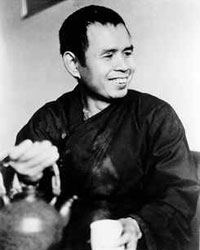
I wanted to do a series of posts about the things I learned at my retreat last week (or so) ago, so here's part 1 of Thich Nhat Hanh's brilliant insights. These are all distilled from dharma talks that TNH gave during the first days of the retreat.

*The present conditions are sufficient for happiness. We spend so much of our life waiting for a moment to come when we will be happy. "Ugh, I can't wait until I finish school/get married/get divorced/see my family/escape my family/get a job/etc." However, when we think that way, we are entirely ignoring the present moment and living in a time not present, either past or future. "I wish that our date/party/dinner/lesson/retreat/concert had been longer." We have little concept of how wonderful each moment is, and can be within ourselves. Suffering will always exist in our life, but we have a choice whether to indulge it or simply acknowledge it and move on.

*To cultivate happiness, you must leave behind your initial concept of happiness: it may be preventing you from accepting the present moment. If you release your expectations, then the present moment may be quite enjoyable, after all. Mindfulness can help you realize that happiness is here and now. Concentration can also be a source of fulfillment and joy, as well as mindfulness and insight.

*To love is to offer. What do you offer to others and to yourself? To love also means to "be there," to offer your presence. If you are not "there," how can you love or be loved? When mind and body are united, you can truly offer and receive love. When you are present, and you acknowledge another's presence, you are giving love and recognizing their love. Lastly, you can offer understanding. Every person wants and needs to be understood, and many of us thirst for that understanding from others. It's misunderstanding that leads to strife, fighting, and pain.

*One example of terrible misunderstanding is war. Terrorism is when everyone thinks "He's trying to kill me and I should kill him before he kills me!" However, these thoughts are from wrong assumptions, which can only be solved from listening and compassion, not guns and bombs. It's important to acknowledge the suffering of both sides in a war- those who kill must suffer in order to kill, and those who are hurt are often victims of an unpleasant government. Every sequence of events politically can be traced back to various harm from different countries, and everyone is to blame in causing the ills. Bush is not the only one to blame for invading the middle east, and we let him do it. If we tried our best to resist it, then we have done our best. However, everything and everyone is connected, and no one can be truly happy when others suffer so much in the world and one ignores it. (I don't think I explained that one too well!)

*So much of our day to day emotions are neutral or unpleasant, but compared to other moments in our life, should actually be quite pleasant. For example, when you are ill, you suffer so much, and you think, "oh, if only I could be well!" But when you are well, you rarely think, "Hmm, I am grateful for my lack of headache, grumpiness, congestion, etc." Putting our less thrilling moments in this context can make us realize the beauty of all moments.

One of the things I loved so much about the retreat was just getting to see Thay (TNH). He is so calm and deliberate in all of his actions, and it is as though he could never get angry with everyone. He is so aware of everything and everyone, and this comes through just in the way he walks and talks with everyone. Having read a few of his books, it was amazing to see how his ideas really work in a practical sense with monks and nuns and an intentional community of people. It made me realize that I need a sangha of practitioners, of like-minded people who want to make the world a better place through mindfulness, love, and understanding. I feel like I learned so much from my retreat, and I can't wait to join a sangha, go on more retreats, and read more of his works. Everything he says is so practical, yet so powerful. To acknowledge that war, strife, argument, and anger is all a consequence of suffering (both yours and the other side), is momentous. Just in these few highlights, one can see how to live life differently, how to appreciate every moment in a different view, and how to re-evaluate love. To those of you who have read TNH's stuff, I look forward to your insights, and I look forward to growing as a person in the world.

Currently: watching the new season of Flight of the Conchords! Listening to ipod on shuffle. Currently reading TNH's book "buddhist ethics for a new century" or something like that.