Showing posts with label time. Show all posts

Tuesday, August 17, 2010

The Strange Overlaps Between Garp and Toy Story 3

Over the weekend, I finally saw Toy Story 3 at the cheapy theater in my neighborhood for a whopping $2.  Everyone had raved at the plot complexity, the cleverness of the toy references, and how it made them cry.  Strangely, my first reaction was a dismay at our trash system, and how things are thrown out that have no place in a landfill.  The infamous trash scene also reminded me of "The brave Little Toaster" and the animated, singing trash dump scene with the cars being smooshed into little boxes of metal.  I definitely enjoyed the movie, and it was absolutely worth my two dollars, but it almost made me sad about how much trash is in the landfill and how much we consume as people.   I guess there's always a little Wall-E residue in a pixar movie, and that was what I got from it at first.  Of course, there's a wonderful point about recycling your toys, even though one might want to keep things forever, there's more value in sharing, recycling, and reusing other's things, which I also like.  But the real clincher for me, was when Andy had packed up his room, and his mother started crying, and said "I just wish I could be with you forever."  Weird, how that got me the most, right?
I've just been rereading John Irving's famous epic 'The World According to Garp,' which is an interesting story about a man, his writing career, and his relationship with his mom and his children.  One of Garp's main paranoia's is towards his children-he runs after cars on the street to tell them to slow down, he rescues one of his sons from a sleepover with a sketchy mom, and he constantly fears for his children's lives.  Sadly, (or ironically) one of his sons dies in a mostly preventable car accident, and the other son loses an eye.  He is so caught up in his fears that he never looks at his own actions as causing danger for the kids, and he instead worries about the unknown, the "under toad" as it is referred to.  I can definitely identify with this fear and anxiety, as I'm often worried that my parents will have an accident or something like that.  As an only child, my parents are my only real family.  I'm not close with aunts or uncles or cousins, which has always slightly worried me, since my parents' eventual death will leave me alone in the world.  Garp's fears as a father are my fears as a child, and are Andy's mother's fears.  We can't control what happens in other's lives; we can't protect them forever, and we can't really tell them what to do.  I'm so happy that my parents have become much more healthy than they used to be-each of them has lost a significant amount of weight, and they eat a heavily raw plant and semi-vegan diet, which excites me, even though they would never call it by that label.  I still worry about them sometimes, but I know I need to let things unfold.  They can't be with me forever, and I can't be with them forever.  It's more about being present in the moments that you do have together, and letting people know you care.  That's the best I can do, at least.
listening to: the new arcade fire album

Tuesday, September 22, 2009

The Phantom Tollbooth and Life


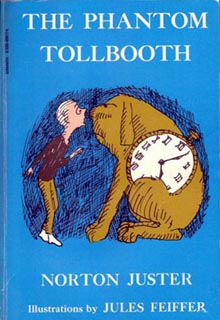
Last weekend, when I drove for 16 hours in two days for a wedding (ahem!) I had many opportunities to self-reflection, drowsiness, observing the landscape around me (Pennsylvania? Amish folk?), and listening to things. One of the things I listened to was the The Phantom Tollbooth, by Norton Juster, narrated by David Hyde Pierce. And it was lovely.

First of all, the book was written written in 1961, and has fabulous illustrations by Jules Feiffer which still stick in my head, even when listening to the book. The book is a witty adventure story, in which Milo, a boy with endless ennui, goes on an adventure because of a mysterious tollbooth that manifests itself in his room. Milo visits all sorts of places: dictionopolis (where words are bought and sold and are edible!), expectations (imagine the puns), digitopolis, the mountains of ignorance, and what not. Before receiving the tollbooth, Milo was a very dissatisfied person: he was never happy, no matter what he was doing, and he was always looking to be where he wasn't. He was always looking forwards or backwards, and could never be present. (Well, doesn't that sound familiar????) Milo's subsequent adventures teach him the value of many things that he took for granted, such as:

1) Education: Milo realizes that he has so much to learn about words, numbers, sounds, wisdom, and that when you learn something, you never know when it will be useful again.
2) How to appreciate life as it is. Milo is unhappy initially with his array of toys, his life, etc, and he realizes that he takes everything for granted!
3) Generosity and concern for others: Milo learns to care for Tock and the Humbug, and to try to help others when their plight is grave. By rescuing Rhyme and Reason, Milo is learning to help others as a means to help himself.
4) Time: The most significant character in the book, aside from Milo, is Tock, the WATCHdog. He is always reminding Milo to use time wisely, to know that time passes quickly, and that everyone's presence is a temporal gift. Tock teaches Milo to be mindful of his life and time. And at the end of the book, there is a very interesting issue in which Milo must go home to his own life and family, and despite his desire to stay in the kingdom of wisdom, he realizes that everything changes, and all things end. (Hmm!!!!)


For me, as a buddhist-y children's lit loving girl, this book was as powerful as it was when I was smaller. It teaches us how to become aware of our lives, how to be curious, to be mindful, to be kind, to be generous: all without being didactic or condescending. In some ways, it is almost spiritual in trajectory- Milo's adventures teach him mindfulness and awareness, skills we all aim to develop. Some of the quotes were so poetic, so relevant to Buddhist philosophy, and perhaps all philosophy, that I'll share a few.


"But it's not just learning things that's important. It's learning what to do with what you learn and learning why you learn things at all that matters."

"..the most important reason for going from one place to another is to see what's in between, and they took great pleasure in doing just that. Then one day someone discovered that if you walked as fast as possible and looked at nothing but your shoes you would arrive at your destination much more quickly. Soon everyone was doing it. They all rushed down the avenues and hurried along the boulevards seeing nothing of the wonders and beauties of their city as they went.No one paid any attention to how things looked, and as they moved faster and faster everything grew uglier and dirtier, and as everything grew uglier and dirtier they moved faster and faster, and at last a very strange thing began to happen. Because nobody cared, the city slowly began to disappear. Day by day the buildings grew fainter and fainter, and the streets faded away, until at last it was entirely invisible. There was nothing to see at all."

“You’ll find,” he remarked gently, “that the only thing you can do easily is be wrong, and that’s hardly worth the effort.”

"You must never feel badly about making mistakes," explained Reason quietly, "as long as you take the trouble to learn from them. For you often learn more by being wrong for the right reasons than you do by being right for the wrong reasons."